Shopping cart
Your cart empty!
Your cart empty!

Join 10k+ people to get notified about new posts, news and tips.
Do not worry we don't spam!
Jan 15, 2026 • 634 views
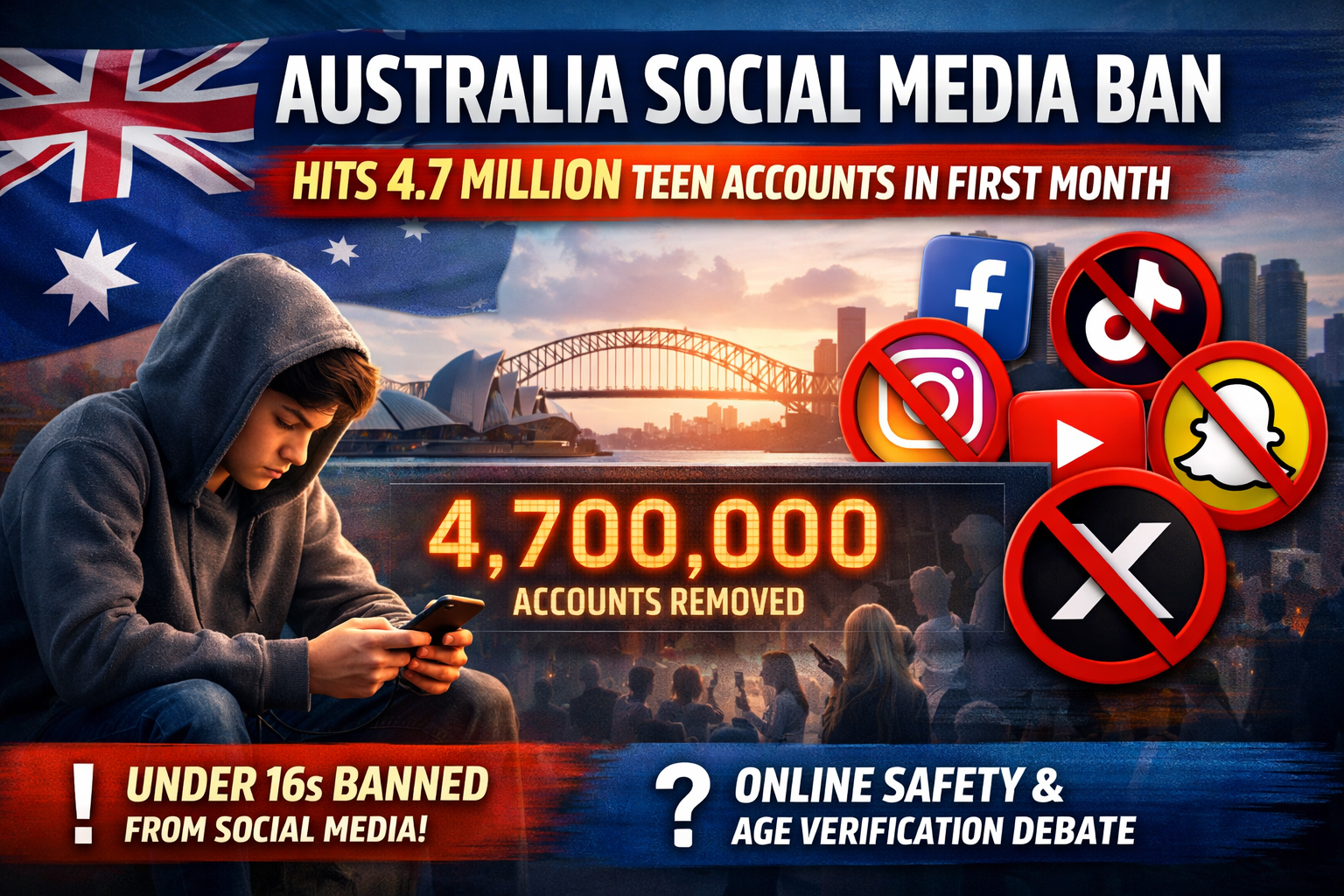
Australia has taken a groundbreaking step in digital regulation — and the world is watching. In December 2025, the Australian government implemented a world-first ban on social media accounts for individuals under the age of 16. Just one month into enforcement, around 4.7 million teen accounts have been removed from major platforms, highlighting both the scale of the policy and the challenges of its implementation.
The Australian government passed the Online Safety Amendment (Social Media Minimum Age) Act 2024, a regulation aimed at reducing harm to children and adolescents online. Under this law, major social platforms must take “reasonable steps” to prevent users under 16 from holding accounts or face hefty fines (up to AUD 49.5 million per platform).
Supporters of the ban argue that social media exposes young minds to addictive algorithms, risky content, cyberbullying, and privacy threats — issues that parents and child advocates have warned about for years. By enforcing a minimum age, the government hopes to shield teens from these online pressures and promote healthier childhood development.
Since the rules took effect on December 10, 2025, platforms such as Meta’s Facebook, Instagram, Threads, Google’s YouTube, TikTok, Snapchat, X (formerly Twitter), Reddit, Twitch, and Kick have been asked to deactivate or restrict accounts believed to belong to under-16 users.
According to government figures:
Approximately 4.7 million accounts owned by teens were deactivated, removed, or restricted in the first month.
This number significantly exceeded early estimates, equating to more than two accounts per child aged 10–16 in Australia.
Meta alone stated that it shut down about 550,000 suspected underage accounts across Facebook, Instagram, and Threads early in the enforcement period.
These figures reveal not just the scale of teenage social media use, but also the immediacy with which platforms acted to comply — even as age verification systems continue to evolve.
While millions of accounts have been identified and removed, the ban isn’t without its critics and logistical hurdles:
Platforms must determine a user’s age — a notoriously tricky task online. There’s no universal method to verify age without privacy concerns:
Some companies use AI-based age inference and facial recognition.
Others may require government ID uploads or other identifiers.
False positives (incorrect age detection) and false negatives (missed teen accounts) remain ongoing issues.
There is also debate on what counts as “reasonable steps,” since some platforms still allow users to view content in a logged-out state even without an account.
Meta and other tech giants have publicly raised concerns that the ban may simply push teens toward less regulated or obscure platforms (like Yope or Lemon8), or even circumvent age checks with tools like VPNs. This could inadvertently create safety blind spots.
Legal challenges — such as one being pursued by Reddit — argue that the ban can limit freedom of expression and hinder teens’ ability to engage civically.
Australia’s move is being closely watched around the world. Other countries, including parts of Europe and Asia, are considering similar age-based digital safety laws. Supporters say it could inspire broader regulation to protect youth online, while skeptics argue it raises complex questions about freedom, enforcement, and unintended consequences.
Australia’s social media ban for under-16s represents one of the boldest experiments in digital governance. With millions of accounts already affected, it shows both the power of regulation and the difficulty of policing digital spaces. As age verification tools improve and platforms adapt, this policy could evolve — and perhaps inspire similar laws globally.
Whether seen as a necessary shield for young minds or a controversial overreach, this policy marks a turning point in how societies approach tech regulation and youth wellbeing.